

TL;DR: People pleasing is NOT a mere habit of being nice. It is a nervous system attempt to dismantle what it perceives as a danger. (=people being disappointed/ leaving/ expressing big feelings)
Good news: It needs not forever be that way.
Background: Nervous system 101 / the 4 Fs
Below is a rather simplified understanding of the Nervous System 4 Fs: Fight, Flight, Freeze and Fawn. It’s a table which you may begin reading from its middle. I could not find an illustration depicting this which I wanted to illustrate, so I made one. (Be the change you wish to see much?)
One picture is worth a thousand words. How many words is a table worth? Hopefully enough. (If you listen to this article on your substack app and are able to, give the table a look. I added alt text for the visually impaired but it fails to capture all aspects of the table.)
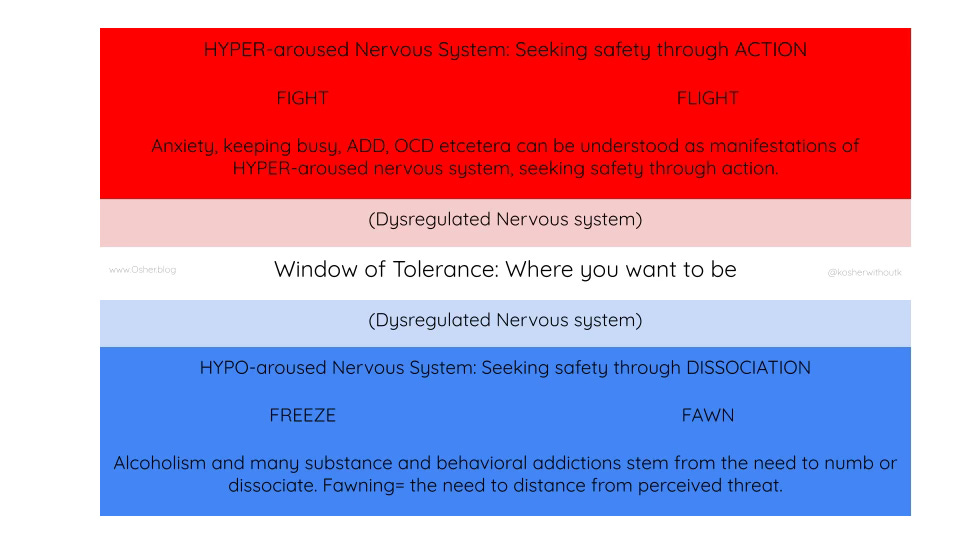
A HYPER-aroused nervous system seeks safety through action, via FIGHT or FLIGHT states. The danger need not be an actual one, mind you. Nor does the response. The danger can be simply feeling inadequate physically / financially / socially / professionally etc. The responses? Anxiety, keeping busy, ADD, OCD and more, can all be understood as manifestations of a HYPER-aroused nervous system, seeking safety through action.
On the other side of the pendulum, a HYPO-aroused nervous system seeks safety through dissociation, via FREEZE or FAWN. Alcoholism, substance addictions such as opioids, benzodiazepines and more as well behavioral addictions- (video game / porn / gambling / binge watching / doomscrolling..) all stem from freeze, and can be understood as attempts to find safety by dissociating. While dissociating does not solve the problem, it temporarily distances one from it (by distancing them from themselves). It’s like saying- the baby is crying, let’s get out of the house.
It is worth noting that many people may spend most their lives zig-zagging between hyper-aroused and hypo-aroused nervous system, likely hyper-aroused during work and hypo-aroused during down time. Alternating from go-go-go, not a quiet moment, to completely checking out by whichever means.
That covers the 3Fs mentioned thus far: Fight, flight and freeze. Let’s get to the reason we’ve digitally gathered here, that 4th F.
The orphan F: FAWNING
Of the 4 nervous system responses, one stands alone for being least known and least understood: Fawning. Fawning’s PR fail is not limited to the general population. The 4th F is at times omitted out of professional presentations, articles and even books.
What IS fawning? Fawning is a nervous system response whereby someone appeases or submits in order to avoid displeasing someone else, a reaction they perceive as dangerous.
What may fawning look like: Constantly scanning the surrounding for others’ needs, predicting and vigilantly working to address those even before they arise. The person fawning not only neglects their own needs, they oftentimes won’t even know to articulate what their needs are. The thought of disappointing others may cause their heart rate to rise, their breathing to quicken. The mere suggestion of prioritizing their own needs may bring up intense feelings of guilt in them. Other fawning related feelings and behaviors may include: Constantly apologizing for things not remotely within one’s own responsibility or control, feeling exhausted and / or brewing with resentment inside but unable to stop.
How common is it? According to a YouGov 2022 survey 1 in 2 people identifies as a people pleaser. That is half the population. Fawning is more common in women and is excepted if not encouraged in some cultures.
How is a fawner born? More often than not, (but certainly not always) fawning is a survival mechanism that is learned early on. The fawner may learn as a child that if they don’t excel in school or sports / take care of the household or others’ needs, chaos ensues. Chaos is dangerous. Fawning is a brilliant survival mechanism. One cannot fight or flee the danger or dissociate from it, so they dismantle it instead. And so “Mom / dad flips when I don’t…” or “Mom / dad is less likely to be upset when I…” becomes a lifelong pursuit of “my partner / boss / child / client.. will be unhappy / explode / be very disappointed if I don’t..” or: “So long as I behave / overextend myself / keep X happy, all is well”.
The cost of fawning: Children who are forced into parentification- a role reversal by which they become the care-taker / confidant / mediator to their parents or guardians, are not just wired to prioritize others’ needs. They experience Alexithymia- the inability to identify and describe one’s own emotions. The close link between Alexithymia and fawning is not limited to those who developed them in childhood. Self abandonment has no age limit.
Is fawning a trauma response? Let us pause a moment on the difference between trauma response (post trauma / danger happened) VS nervous system response (a way to avoid danger and not just a response to it). So: Fawning can be a trauma response, and for many it is. Yet it is not just a trauma response, it is a trauma avoidance mechanism = nervous system response. Defining fawning merely as a trauma response leaves out the very many who may not have felt the wrath of disappointing others, but the mere risk thereof generated a fawning behavior response within their nervous system.
Fawning’s best disguise: Many fawners will say: “I’m just a nice person / a care taker / good at my job…” This disguise can be undressed with an honest inquiry: Do you know your own needs? Can you safely communicate your needs and have them met within the appropriate boundaries of relationships? What happens if you fail to address said person’s need? What happens in your body to the thought of failing to address others needs? Being riddled with crippling anxiety by the thought of disappointing another is not a healthy nice person response. That is a nervous system response. Here’s an easy rule of thumb:
Being nice feels expansive. Fawning feels constrictive.
Fawning’s dark side: There is an element that is often left out of conversations about fawning. Fawners often attract manipulators. Think about it: Who is an abusive boss more likely to hire / keep under their employ? Who is an abusive partner more likely to go into a relationship with? The person who exercises healthy boundaries and asks for their needs to be met or the person who profusely apologizes when the boss / partner loses their temper, works tirelessly to avoid disappointing them at any cost, unreasonable as it may be to their own well being?
The drama need not be of a risk to the fawner in order to register as danger. “When I tried to quit / walk away / break up with them they had a panic attack / meltdown / had an inflammation flare-up..” is enough for fawners to register as something to avoid at all costs.
At times the party being fawned over will use toxic positivity to encourage fawning: “You never rest / sleep / complain / get upset / go home..” are subtle ways to signal to fawners: Your lack of boundaries is celebrated and expected.
Is fawning just conflict avoidance? No. While there is certainly an overlap to this Venn diagram, there can very well conflict avoidance sans fawning (withdrawal, not actively pleasing) and there can be fawning sans conflict avoidance (habitual, on-going, without an immediate risk of conflict yet stuck in “appease to survive”.)

Overcoming fawning
Recovering fawners demonstrate that fawning can very well be overcome, yet it requires diligent work, and transformation of habits and relationships alike. Spoiler alert: Some unhealthy relationships may not survive this healthy transformation.
The scope of healing a lifelong nervous system response is greater than what a single substack article may cover, but I’ll do my best to give pointers to help fawners navigate the path to recovery.
Ground in present moment physical safety. Hopefully you read this as an adult. The capital D danger that sent you on to the path of fawning, is over. You are no longer a child and the person/ people who turned you into a fawner cannot physically harm you. Let your body know: “I am safe. You are safe. We are safe.” (If you are not in fact safe and are in a physically abusive relationship, help is available, text BEGIN to 88788)
Establish other layers of safety (financial / housing/ professional / social): A lot of therapy minded articles skip over this step. Some fawners may exist within a culture / a household/ a workplace where setting a boundary may come at a real cost. Some fawners may have financial / professional / housing dependency towards the person they’ve been fawning over. The danger here, albeit not physical, is real. One can lose their income / the roof over their head etcetera when they cease fawning. It is difficult to tell the nervous system that the danger is over when some danger is still imminent. In such cases, before making the shift it is important to do all that is within one’s power to bring safety to these areas and navigate the transition with grace. Inform and consult with trusted individuals within the relevant professional / familial / social / cultural network. Recovering from fawning in a Canadian corporate environment is different than recovering from fawning in a middle eastern family setting.
Update the script: Once basic levels of safety are established, you can go into a deeper inquiry around emotional safety. This may take different forms for different people: It is safe for me to disappoint others. It is safe for me to articulate my needs. It is safe for me to ask that my needs be met. It is safe for me to be in the company of others having big feelings. Others’ big feelings are not a danger to me. Each one of these sentences is not merely a mantra and may require updating long held rigid beliefs. Working with a trusted professional in a supportive environment may come in handy right around here.
Baby steps. Start small, when stakes are low, and work your way up. If “I rather not” feels impossible, perhaps begin with: “Can I think about it?” Take your lunch away from the desk before requesting / announcing a week long vacation.
Intervention script. Learn to identify the signals which arise in your body when the need to fawn comes up. What happens to your breath? your heartbeat? (ask a professional to help you) design a short exercise that will help you ground in safety, regulate your nervous system and communicate from a safe place.
Hello, Self. Learn to recognize your needs, learn to articulate them to self, and with time- to others. Many fawners will scramble for an answer when asked: “What do you need?” It is therefore important for recovering fawners to tap into their feelings and learn to articulate their needs, first to themselves and in turn- to others.
The bigger reframe: This is an important one: If I am not a people pleaser- WHAT AM I? A lot of people have an identity rooted in people pleasing. They may think: If I am not a people pleaser I am selfish / unlovable / unemployable.. Many of us were taught: “Do unto others as you would have them to unto you.” When in fact, for recovering fawners and most normal individuals, there isn't a person we treat less kindly than ourselves. So the invitation for the recovering fawner is to introduce the flipped golden rule. (the silver rule?) To treat oneself as they would another. And then- rooted in safety, one can very well indulge in being nice to others from a healthy place. Being nice to others because they get to, not because they got to.
<A note for the non-fawners: You may not be a fawner, but certainly you know one. They may even be fawning over you. Independently of whom the fawners in your life fawn over- I hope you can use this awareness to gently support them on their journey of recovery. They will forever cherish you for it.>
How does fawning show up in your life? In yourself or a loved one? feel free to share in the comments. Happy recovery to all fawners.
***
If you’re interested in practicing healthy boundaries in community, learning to safely hold space without depleting and allowing yourself to receive and be held, consider joining our next retreat: https://pp.events/witness
Want to learn more? request a free discovery call Hello@houseof42.org

Depression is a disease of neurons as much as traffic is a disease of cars.

A Cornell University study allows for a better understanding not only of psilocybin, but of depression, the brain, and the human experience.

This is such a clear and generous breakdown, and I love how you name fawning as intelligent, not just dysfunctional. That reframe matters. And… I find myself sitting with the part that isn’t always said out loud: for a lot of women, this isn’t just a nervous system pattern—it’s a socially reinforced one. We were rewarded for anticipating needs, praised for being “easy,” chosen for how little we required. So the body learns quickly: this keeps me safe. This keeps me loved. This keeps things running.
Thank you so much for sharing. I've been pondering this deeply over the past week. I'm a life-long fawner and a lot of my healing journey the past year (through breathwork and medicine) has illuminated how these patterns formed, and how to break out of them.
I've been thinking a lot about fawning and how it erodes your own personal integrity: when you sacrifice yourself you not only hurt your own being, but potentially that of the person you are pleasing. A line from a mentor that sticks with me is a prayer she offers before working with someone that is something like: "I choose to release all need to be the answer for other people, or to become the comfort that would displace the challenges that would allow them to grow." Stepping into your own sovereignty allows others to do the same.
I'm still learning how not to be the comfort of others (my default is automatically avoiding conflict and pleasing others), but I am making great progress. A big thanks to Osher for being a huge influence on this path.